
Just One Thing: Richard Hooker Part 2
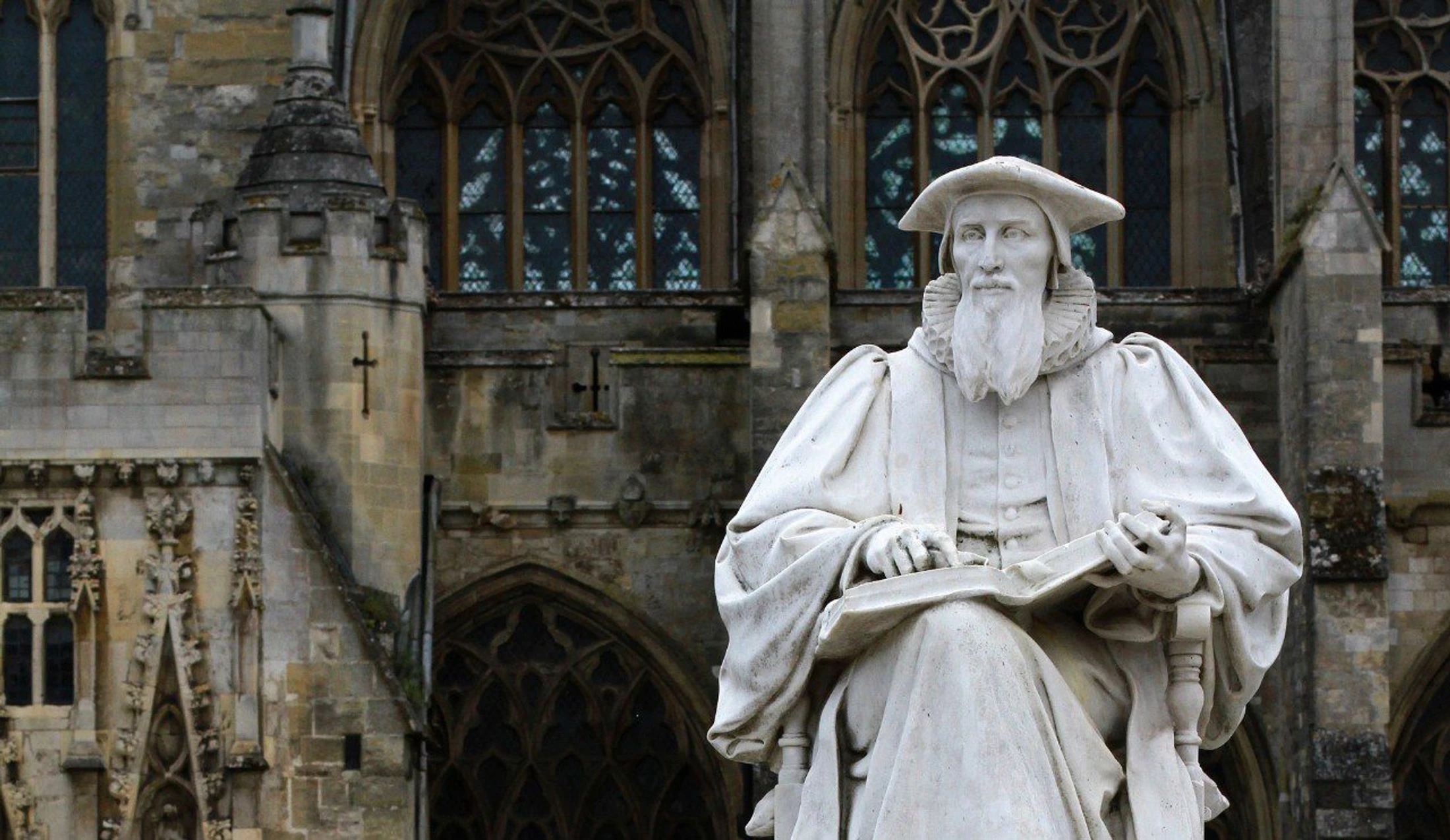
A statue of Richard Hooker stands on the green at Exeter Cathedral in Exeter, England. Created in 1907 by sculptor Alfred Drury.
In December I wrote about the contributions of Richard Hooker to the church. Hooker was the late seventeenth century theologian who was primarily responsible for defining the Anglican tradition. He articulated and defended that mix of Scriptural authority, Protestant doctrine, apostolic tradition, and rational thought that we call Anglicanism. This was decades in coming: Henry VIII and Thomas Cranmer started the ball rolling in the 1530s, while Hooker’s great work, Laws of Ecclesiastical Polity was published mostly in the 1590s. I suggested in December that I might take a later essay to more closely define the differences between Anglicanism and Puritanism. Here we go.
A large handful of things separate one church from another. One question that separates: how should a church be run? That becomes church governance. A second question: how do we organize worship? A third: what authorities has God given us to guide our life together? There are others, but these are a start.
As I mentioned last month, one of Hooker’s significant contributions was defining the Anglican tradition in distinction from the Puritan tradition. When Queen Mary tried to stamp out Protestantism in England, many English clergy went into exile. Many of these Marian exiles, as they are called, landed in Geneva, where they learned Calvinism firsthand from John Calvin. When Queen Elizabeth took the throne in 1558, clergy returned. Many were now Calvinists, angry and grieved, and they insisted on purifying the English church. Hence, they acquired the name Puritans. The arguments between Anglicans who sought a middle way and Puritans who sought more radical change continued for a century.
One cautionary aside: I want to be careful not to exaggerate the differences. Puritans came in many flavors, not quite like Bertie Bott’s Every Flavour Beans, but close. They were united against the archbishop and the monarchy, but after the English Civil War unity lost its value and they split into a variety of denominations. Some returned to Anglicanism, others became Presbyterians, Baptists, Congregationalists, and Quakers. The title “Puritan” is an umbrella term linking people of different convictions in opposition to a common enemy. Like many historical labels, it’s an imprecise convenience that we live with.
Ok, back to Richard Hooker and his argument with Puritanism.
One defining issue was governance. Calvin advocated Presbyterian governance. He argued that a council of laity and clergy should govern the church instead of the traditional hierarchy of bishops, priests, and deacons. Puritans agreed. Hooker (and other Anglicans) argued against the innovation. The church has been governed by bishops, priests, and deacons since apostolic times, he observed, passing on Christ’s authority through the laying on of hands. Calvin’s judgment, in the absence of a general church council, was not enough to overturn 1500 years of Spirit-inspired, Scriptural governance.
Another defining issue was worship. Calvin argued that worship practices should be limited to what is practiced and taught in the New Testament. Worship services should include psalms, preaching, prayers, and the Lord’s Supper, but whatever is not explicitly directed in the New Testament cannot be allowed. Art, religious symbols such as crosses, candles, incense, bells, and more – none of this is part of New Testament directives, and so should not become part of contemporary worship. (In this country, only an occasional Protestant church had a cross before 1830 and they weren’t common until the late 1800s.) Cranmer’s Book of Common Prayer, instead, followed the early church and concluded that the church
was free to decree worship practices as long as it was not contrary to Scripture (Article XX). Hooker was perhaps the most able defender of this idea, arguing against Puritans in his Laws of Ecclesiastical Polity. He noted that many things of value are not mentioned in the New Testament including the word ‘Trinity.’ God has given us additional authorities
to guide the church, including the Spirit, the wisdom of faithful leaders, and rational thought. Hooker argued that elements of worship must not contradict Scripture, but they did not need to be explicitly found in Scripture.
On the matter of authority, Hooker and other Anglicans argued that some Puritans took
sola Scriptura too literally. Luther and Calvin both argued for sola Scriptura, but in doing so they relied on the apostolic fathers, the ancient creeds, and church councils to interpret Scripture. Some Puritans took sola Scriptura to mean that Scripture alone was authoritative. But, as Hooker (and others) pointed out, that is a dangerous position that readily leads to heresy. Sola Scriptura taken literally leads to division and heresy as individuals interpret Scripture for themselves. It’s imperative, argued Hooker, that Anglicans
read Scripture through the lens of the apostolic fathers, creeds, and church councils: the authority of Scripture as received in the historic tradition of the church.
At the risk of losing you in the weeds . . . on predestination, Hooker agreed more with Melanchthon than Calvin: believers are predestined to salvation, but not to reprobation (Article XVII). In other words, the double predestination of many Puritans was rejected in favor of a more moderate Lutheran position.
On the Eucharist, sixteenth-century Anglicans and Puritans were often in agreement: in the Eucharist: Christ is present spiritually. Anglicans here are not Catholic (Transubstantiation) and not Baptist (Memorialism). Hooker was close to the Reformed position but worded things to allow Lutheran consciences as well (Art. XXVIII).
On Baptism, some Puritans declared flatly that baptized infants are not regenerate. The Book of Common Prayer, on the hand, holds that baptized infants are regenerate, in other words, they have received the Holy Spirit and have been welcomed into the church. Here, then Anglicans are closer to Lutherans than to Puritans (Art. XXVII).
To sum: Anglicanism embraces strong elements of the Reformed (Calvinist) tradition, especially in the Eucharist and in Christology, and holds important commitments that are Lutheran and Roman Catholic. All three rest on an Apostolic foundation. It is, in fact, a middle way, an aggregate of Reformed, Lutheran, Catholic, and Apostolic traditions. And Richard Hooker was the sixteenth century theologian who, in a deeply contentious era, most winningly articulated and defended that way.
For more see: Raymond Chapman, Law and Revelation: Richard Hooker and His Writings (2009). Gerald McDermott’s excellent book Deep Anglicanism is helpful. And if you really want to send your hog out searching for truffles, see Fr. Seth Snyder’s article “Reformed Anglicanism: A Critique, found here, and Matthew Kennedy, “The Prayers Rose Like Incense: Anglican Worship and the NormativePrinciple” found here.