
Just One Thing: Richard Hooker
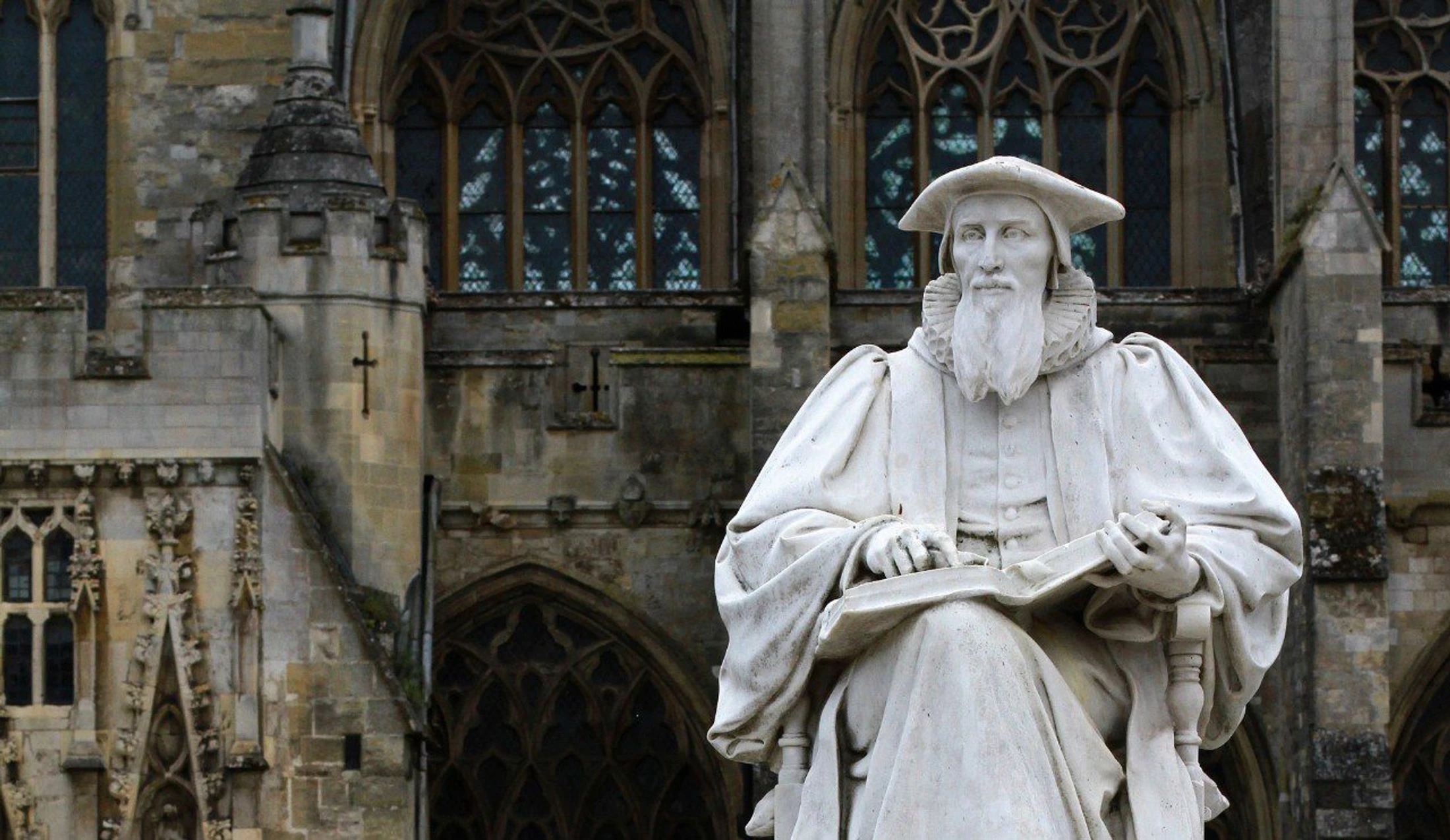
A statue of Richard Hooker stands on the green at Exeter Cathedral in Exeter, England. Created in 1907 by sculptor Alfred Drury.
Richard Hooker. A little context will help. Let me briefly trace the path England took moving away from Catholicism and towards what today we call Anglicanism.
Many of us are more-or-less familiar with William Tyndale, the early 16th c. linguist who first translated the New Testament (and portions of the Old) into English from Hebrew and Greek texts. And we similarly recognize Thomas Cranmer, the 16th c. Archbishop of Canterbury who helped separate the Church of England from Roman Catholic oversight. Cranmer commissioned Myles Coverdale to complete the Great Bible, which was based in Tyndale’s work and became the first full, authorized edition of the Bible in English (1539). Cranmer also wrote the first two editions of the Book of Common Prayer (1549, 1552).
Separation from the Roman Catholic Church was violent, sometimes horrifyingly so. It created religious and political turmoil that lasted for a hundred and fifty years. While some leaders (like Edward VI and Mary I) sought peace that excluded the opposition, Elizabeth I, who took the throne in 1558, sought to bring peace more broadly, peace that would enable opponents to live together. To put the general idea as briefly as possible: under her direction the Church of England remained Protestant in theology while retaining a great deal of the worship and devotional practices of earlier medieval and apostolic eras.
Elizabeth faced opposition from Catholics who were outraged over the violence of Protestant reformers and wanted England to return to Roman Catholicism. This was largely addressed early in Elizabeth’s reign and her answer was robust and definitive. There would be no going back.
But the commitment to be Protestant was more complicated. The question remained: which version of Protestantism? Protestantism was as well-named then as it is now. Church governance might be episcopal, presbyterian, or congregational. Scripture might be the Great Bible, the Geneva Bible, or the Bishop’s Bible. Eucharistic theologies covered the spectrum from transubstantiation to receptionism to memorialism. Protest abounded. Local practices differed widely.
Enter Richard Hooker, an English priest and the most influential English theologian of the sixteenth century. Hooker, more than anyone else, stitched together the blend of biblical authority, Protestant theology, apostolic tradition, and human reason that today we call Anglicanism. His work reflected the tensions of the day. His theological conclusions were adept, accommodating, and workable. They answered Elizabeth’s need at the moment, but they also have stood the test of time.
Richard Hooker, etching by Wenceslaus Hollar, mid- to late 17th century. © National Portrait Gallery, London.
Hooker entered the lists to argue against Puritanism in favor of the Anglican commitments established by Tyndale, Cranmer, and Elizabeth. His great work, Laws of Ecclesiastical Polity, published mostly in the 1590s, advocated for what has become for us familiar Anglicanism. The basics include:
- A deep commitment to the authority of Scripture read and interpreted as the Word of God, divine revelation given for the healing of the nations;
- A similar but subordinate commitment to the apostolic tradition given to the early Church;
- A similar but subordinate commitment to human reason as a divine gift to be used in faith;
- An episcopal church government, in other words, government by bishops, priests, and deacons whose authority comes by the laying on of hands of ordained bishops, thus handing on Christ’s authority through the ages;
- Dominical sacraments of Baptism and Eucharist received reverently and frequently, joined to the recognition that all creation testifies to God’s power and presence;
- Eucharistic theology that accommodates a wide range of Protestant interpretations of Scripture;
- Communal practices of worship organized in the Book of Common Prayer. Hooker’s Book Five is one of the great defenses of the BCP, demonstrating his vast knowledge of biblical and patristic sources, as well as his commitment to human reason.
There is more to be said to clarify those points, of course. They were all deeply contested, as you might guess, but there is no space at the moment to explore how these set Anglicanism off from Puritanism. Perhaps I will pick up that trail in the next essay. But not now.
The other notable thing about Hooker is that he was generous in thought and speech. Even in his highly polemical age—an age not unlike our own in the quality and range of invective—he remained hospitable, fair, and appreciative of genuine Christian faith among those he disagreed with. He condemned neither Roman Catholics nor Puritans but recognized God’s grace in both. Perhaps this helps explain why Hooker’s writing, above other English theologians of his age, remains in print and valuable today. In Hooker we find the moderate Reformed tradition, familiarity with and love for the apostolic age, some Aquinas (notable in the commitment to natural law), and sacramental theology that refused the precise conclusions of Catholics and Puritans alike. It’s hyperbole to say that Hooker created the Anglican via media, but not by much. More precisely, he, more than anyone, articulated a relationship between the major competing authorities of that day—divine revelation, apostolic tradition, and human reason—that allowed a generous orthodoxy to be established. Hooker made the middle way of Anglicanism theologically legitimate. We live and worship and pray in light of his writings still today.
For more see: Raymond Chapman, Law and Revelation: Richard Hooker and His Writings (2009). The bulk of this 200-page text is excerpts from Hooker’s Laws of Ecclesiastical Polity. Chapman included a brief, clarifying introduction. For those with time, Hooker’s complete eight volumes of the Laws of Ecclesiastical Polity are readily available. The Folger Library Edition is the one to read.